
Net Curtains vs Voile Panels: What Should Retailers Stock?
Net curtains and voile panels often sit within a few feet of each other in a curtain shop, yet customers do not always see them as the same purchase. One shopper may come in asking for a simple net to replace what has been at the window for years. Another wants something lighter and more decorative that feels part of the room rather than just a practical screen.
For an independent retailer, the useful question is not which category is “better”. It is whether each one answers a different customer need in your shop, and how much space and stock depth that need deserves.
Net curtains and voile panels are close cousins, not the same purchase
There is no perfectly rigid line between nets and voiles. Both sit within the sheer window-furnishing category, and modern fabrics can blur the old distinctions. What matters more in store is how the customer understands the product and what they are trying to achieve at the window.
Net curtains remain a very familiar buying language. Customers often arrive with a practical brief: they know the window width, they know the drop, and they want a light sheer treatment that gives some daytime screening without shutting the room away from daylight. That makes nets a category where confidence in sizing and availability can matter as much as the design itself.
Voile panels tend to be shopped more visually. They are often chosen because of the way the fabric hangs, the finish at the top of the panel, the colour or texture, and how the window will look as part of the wider room. The purchase can still be practical, but it is more likely to involve styling as well as screening.
When net curtains make sense in a shop
A good net range earns its space by being easy to buy. Customers replacing an existing net do not want to decode a complicated fixture. They want to find the right drop, understand how the width works and see enough of the fabric to know what it will look like at home.
That is why depth in a smaller number of dependable lines can be more useful than a wall of near-identical choices. If a design sells steadily in your catchment, keeping the useful drops available can do more for the customer than adding another pattern that only differs slightly from what is already there.
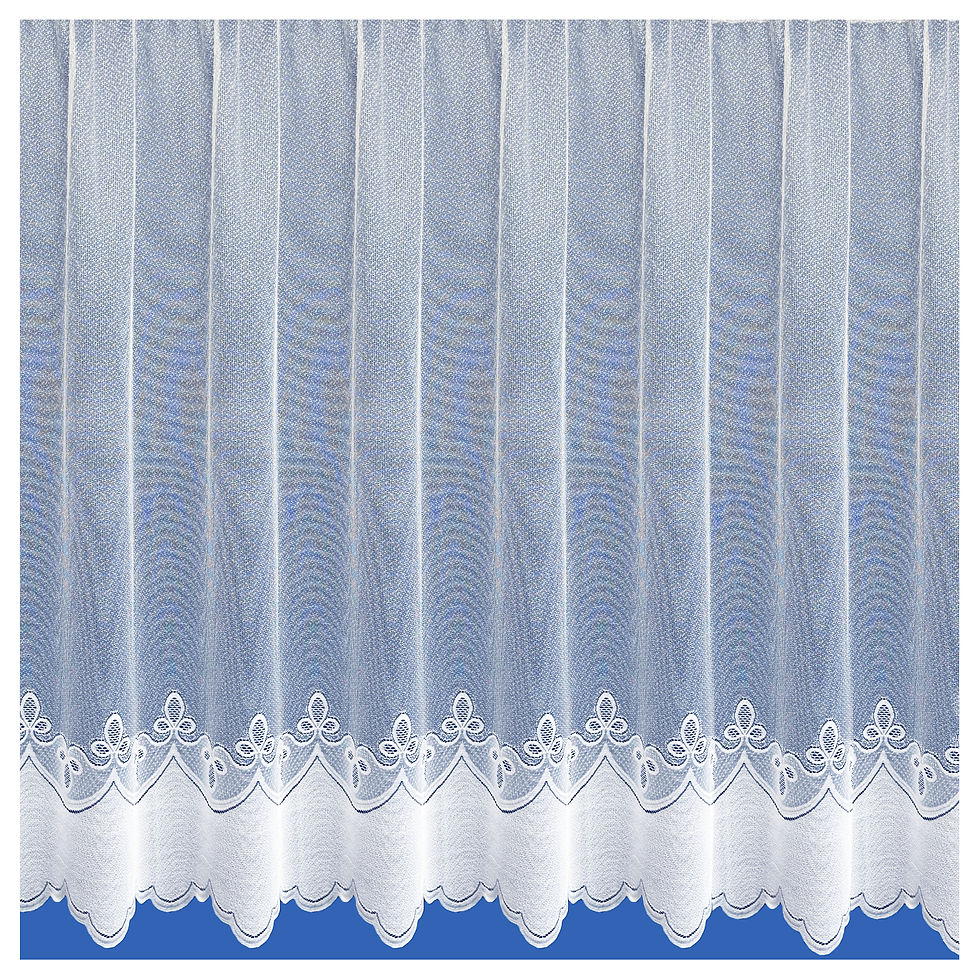
A live example from the current Tyrone range is Geneva. Showing the actual fabric alongside clear size information gives staff something much easier to sell than a closed packet on a shelf.
Where voile panels earn their space
Voiles can bring more variety into the sheer section without making it feel old-fashioned. Plain, textured and patterned panels can sit comfortably in contemporary rooms, and a finished panel format makes it easier for customers to picture the product at the window.
They also work well when a shopper is thinking about the whole room rather than just privacy. A voile can soften a window, add another layer behind a heavier curtain, or simply give a lighter look where a full curtain would feel too much. In store, that makes lifestyle presentation especially useful.

Retailers can see Hannah as one current example of how a voile panel can sit within a broader window-furnishing assortment.
The privacy question needs a careful answer
Privacy is one of the first questions customers ask about any sheer fabric, and it is also one of the easiest areas to overpromise. A net or voile that gives useful screening during the day may look very different at night when the room is lit and the outside is dark.
The safest and most useful answer is to talk about the actual fabric, fullness and lighting conditions. Neither “net” nor “voile” is, by itself, a guarantee of complete privacy. If full night-time screening is the customer’s priority, a sheer treatment may need to be paired with another window covering.
How to build a range without carrying everything
A balanced sheer range does not need dozens of options. It needs enough choice to cover the main reasons people buy, while keeping the fixture simple enough for customers and staff to understand.
Build the core around neutral shades that work easily with different rooms.
Keep sensible depth in the drops and sizes that genuinely sell through your shop.
Use a smaller number of decorative or textured choices to give the range personality.
Make the heading, width, drop and pack format obvious so the practical information does not get lost behind the design.
The mix should also reflect the catchment. A shop with a strong replacement-net trade may need more depth in traditional sheer products. A store selling a more decorative home-furnishing offer may find voile panels deserve more space. Your own sales pattern is a better guide than trying to force every store into the same percentage split.
Merchandising sheers properly matters
Sheer fabrics are difficult to judge inside a packet because their character comes from light passing through them. If space allows, hang a sample where daylight or a lit backing can show the transparency, texture and pattern properly. It immediately answers questions that a pack image cannot.
Keep nets and voiles close enough that customers can compare them, but signpost the difference in a way that makes sense to a shopper rather than to a supplier. “Simple everyday sheers” and “decorative voile panels”, for example, are more useful starting points than a fixture built entirely around technical terminology.
This is also a category where staff knowledge matters. Asking “Are you replacing an existing net, or are you changing the look of the room?” often gets to the real brief faster than asking the customer whether they want a net or a voile.
Keep both categories if your customers shop them differently
For many independent curtain and home-furnishing retailers, there is a sensible case for carrying both. Nets cover a familiar, practical replacement purchase; voile panels can bring a more decorative route into the same sheer-window category. The right balance comes from watching what customers actually ask for and keeping enough stock behind the lines that do the work.
Tyrone Textiles has supplied retailers with window soft furnishings since 1978 and today its trade range includes net curtains, voile panels, ready-made curtains and cushions. That breadth makes it possible to build a sheer offer that sits naturally alongside the rest of a curtain department rather than treating nets and voiles as isolated products.
For a wider look at the trade range, read our guide to wholesale curtains, voiles and net curtains for trade buyers.
Frequently asked questions
Are net curtains and voile panels the same thing?
Not exactly. The terms overlap, and modern sheer fabrics do not always fit into a rigid technical divide. In shops, customers often use “net curtains” for a familiar, practical sheer window treatment, while “voile panels” are more often treated as a finished decorative panel. The best approach is to explain the actual fabric, heading and size rather than relying on the name alone.
Which gives more privacy, net curtains or voile panels?
That depends on the individual fabric, its fullness and the lighting on either side of the window. Both categories are sheer, so neither should automatically be promised as full night-time privacy. A fabric that gives useful daytime screening can become much more transparent when the room is lit after dark.
Should an independent retailer stock both nets and voiles?
Often, yes, if customers in the local catchment ask for both. The important point is not to chase endless breadth. Keep enough depth in dependable core lines and use a smaller number of decorative or alternative options to give the range choice without making it difficult to shop.
How should net curtains and voiles be displayed in store?
Show the real fabric against natural or back lighting wherever possible. Keep width, drop, heading type and pack format close to the sample so customers can move from “I like this” to the correct size quickly. A clear hanging sample is usually more useful than relying on a small pack photograph.
Which colours should a retailer start with?
Neutral shades are the easiest place to build a coherent sheer range because they work with a wide variety of interiors. Beyond that, stock decisions should follow the shop’s own sales and local customer demand rather than assuming one national mix will suit every store.
If you are reviewing your net and voile range, the useful starting point is simple: look at what customers are asking for, where you are losing sales through missing sizes or unclear presentation, and which products genuinely deserve more depth. A smaller, well-explained range will usually be easier to sell than a large one that makes the customer do all the work.


