
Curtain Display Ideas: How to Merchandise Nets and Voiles In Store
Curtain displays work hardest when they help customers understand the product quickly. For net curtains and voile panels, that means showing enough fabric to reveal transparency, texture and pattern, making headings easy to compare, and arranging the range so customers can move naturally from a practical need to a suitable style.
Independent curtain and home-furnishing shops have an advantage here. A physical display can answer questions that are difficult to settle from packaging alone: how sheer is the fabric, how does it gather, what does the heading look like and how will a white, cream, grey or coloured voile sit beside the rest of the room?
Start with hanging fabric, not folded packs
Nets and voiles are visual products. Their openness, texture and scale are much easier to judge when a useful section of fabric is hanging vertically. Folded stock still has a place, but it should support the display rather than do all the selling.

Where space allows, show the fabric with some gather rather than pulled completely flat. This gives customers a more realistic idea of how the material behaves at a window and makes comparisons between lighter and denser constructions easier.
Organise the display around how customers actually shop
A useful display does not need dozens of headings. Customers usually arrive with a small number of questions: they want more privacy, more daylight, a particular colour, a certain heading or a style that suits an existing room. Organising samples around those decisions makes the range easier to navigate.
Separate net curtains and voile panels clearly, while keeping them close enough for customers to compare.
Group related colours together so white, cream, natural, grey and stronger shades are easy to scan.
Show different headings clearly rather than hiding them behind the main drop of fabric.
Keep decorative and plainer options visible together so customers can compare design strength.
Use simple factual labels for composition, heading and care rather than overcrowding the display.
Make colour comparison easy
Colour differences that look minor on a screen can be much clearer in store. White, cream and natural sheers can sit very differently beside paint, wallpaper and upholstery, while greys and darker neutrals can change the feel of the whole window.
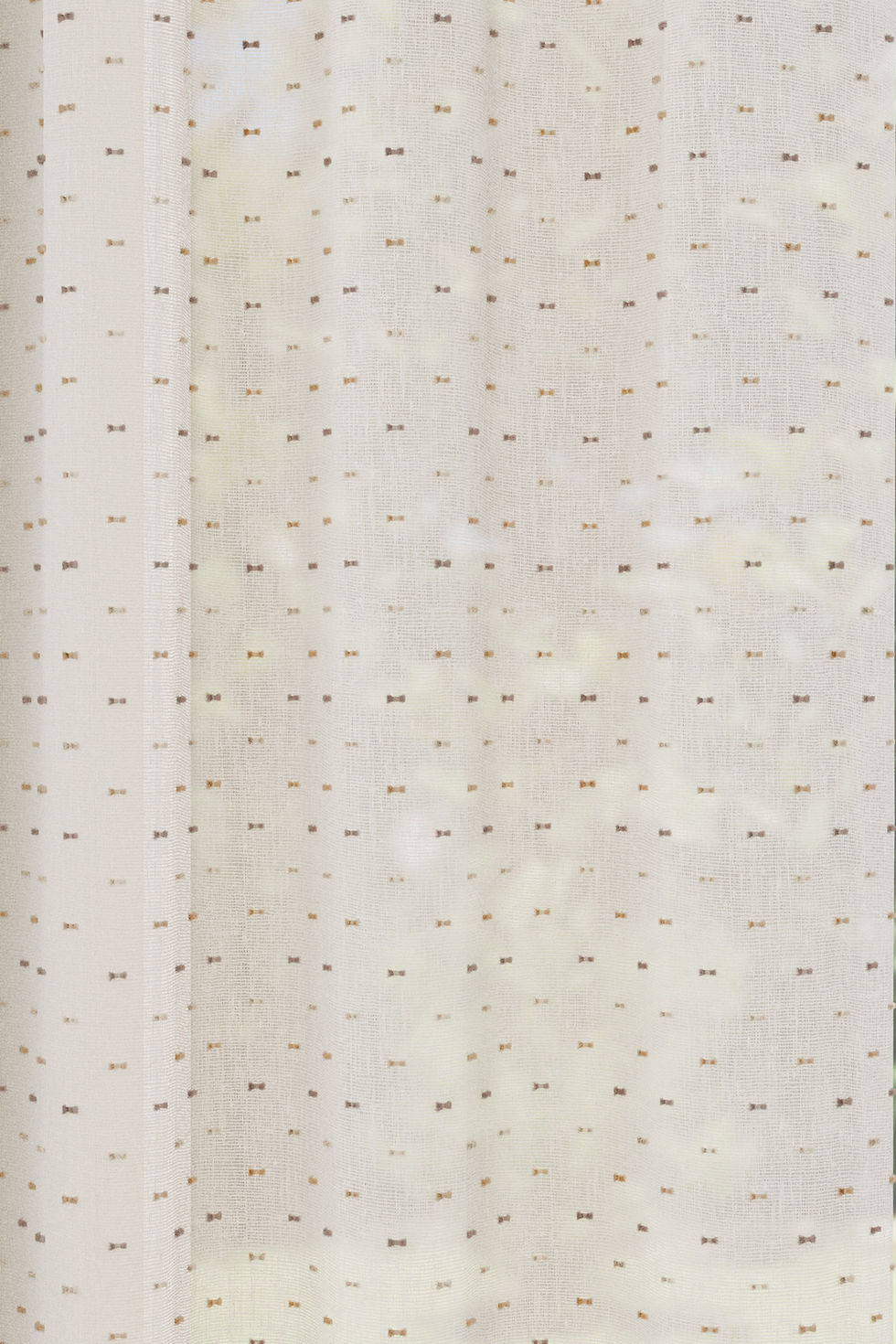
Keep neighbouring shades close enough to compare, and try to show them under the normal lighting conditions of the shop. A customer deciding between two neutrals benefits more from seeing them side by side than from reading a long colour description.
Show the heading as part of the product
The top of the curtain should not disappear behind a display rail. Eyelets, rod pockets and other headings affect both fitting and appearance, so customers need to see them. A short labelled sample can often explain the difference faster than a paragraph of instructions.
If the shop carries several heading types, use a consistent label format and keep the terminology the same across displays, packaging and staff advice. That makes it easier for customers to move between ranges without having to relearn the language.
Use contrast to make texture and pattern visible
A sheer fabric can disappear visually if it is displayed against a background that is too similar. A contrasting backing card or display surface can help customers see weave, motif and openness without suggesting that the backing is part of the product.

For patterned nets or decorative voiles, show enough width and drop for the repeat or motif to make sense. A tiny swatch may show the yarn and colour but miss the overall design completely.
Keep the display commercially manageable
A display should help sell the stocked range, not become a museum of every sample ever supplied. Remove discontinued lines promptly, replace damaged or yellowed samples, and review the balance of colours and styles as the assortment changes.
A smaller display that accurately reflects available stock is usually more useful than a large display full of lines customers cannot buy. It also gives staff more confidence that the sample in front of the customer matches the product they can actually order.
Connect nets and voiles to the rest of the window
Nets and voiles do not have to sit in isolation. Showing them near ready-made curtains helps customers understand layering: a sheer layer can remain at the window during the day, while the main curtain provides a different level of coverage and a stronger decorative element.
This is also useful for coordinated selling. A customer choosing a plain voile may want a patterned ready-made curtain, while someone choosing a decorative net may prefer the heavier curtain to stay visually quieter.
Give staff a few reliable talking points
The best display still benefits from clear staff guidance. Keep the talking points factual and repeatable: what type of product it is, the heading, the composition and care instructions, plus any verified product-specific performance information. Avoid turning general characteristics of sheers into promises that have not been verified for the individual product.
For customers deciding between the two categories, our net curtains vs voile panels guide gives a useful comparison.
For more on balancing shades across a retail assortment, see our curtain colour ranging guide.
A simple display checklist
Can customers see a useful hanging section of the fabric?
Are colours and related styles easy to compare?
Is the heading visible and correctly labelled?
Are composition and care details accurate?
Are discontinued or unavailable samples removed?
Does the display help customers connect sheers with the wider curtain range?
Make the display do some of the explaining
Good curtain merchandising reduces friction. When customers can see the fabric hanging, compare colours, understand the heading and connect the sheer layer to the rest of the window, staff can spend less time explaining basic differences and more time helping with the final choice.
Tyrone Textiles supplies net curtains, voile panels, ready-made curtains and soft furnishings to independent retailers and trade customers. A clear in-store presentation helps those categories work together as a practical window-furnishing offer rather than as isolated product groups.
Curtain display FAQs
Should net curtains and voiles be displayed hanging or folded?
A hanging sample is usually the clearest way to show transparency, texture, pattern and gather. Folded stock can then support the display for customers ready to buy.
How should curtain colours be arranged in store?
Keeping related shades close together makes comparison easier. White, cream, natural, grey and stronger colours can be grouped so customers can quickly narrow the choice.
Why should the curtain heading be visible?
The heading affects fitting and appearance. Showing it clearly helps customers understand whether the product suits their pole or other window arrangement.
How often should curtain displays be reviewed?
Review them whenever the stocked assortment changes and regularly enough to remove damaged, faded or discontinued samples. The display should reflect products customers can actually buy.
Should nets and voiles be displayed near ready-made curtains?
They can be. Showing the categories together helps customers understand how a sheer layer and a main curtain can perform different roles at the same window.


