
Net Curtains or Voile Panels? Helping Customers Choose
A customer asks for something light at the window. They want privacy, but they do not want to lose the daylight. Do you show them a net curtain or a voile panel? Both can suit the brief, yet the right recommendation depends less on the name of the fabric than on how the customer lives with the window.
For independent curtain shops, this is a useful conversation to have early. It narrows the display, prevents assumptions about privacy and helps the customer leave with a window treatment they know how to fit.
Start with the window, not the fabric
Ask where the window is, what faces it and when privacy matters most. A kitchen window looking towards a neighbour may call for a different solution from a wide living-room window overlooking a garden. Ask whether the customer wants to keep the window covering in place all day or draw it back regularly.
A second question is just as important: are they replacing an existing net on a wire or track, or starting with a new pole or fitting? Customers sometimes use ‘net’ and ‘voile’ interchangeably, but their preferred way of hanging the fabric can make the decision much simpler.
When a net curtain makes sense
Traditional net curtains are familiar, practical choices for windows where customers want daylight and a degree of daytime screening. They can be particularly useful for shorter drops and for customers who prefer the look of a fitted net across the lower or full window.
Show the customer the actual pattern and fullness rather than promising a fixed level of privacy. A net that looks opaque when gathered in a sample may look different stretched across a large window, especially when the light changes.
For a straightforward example, the Hudson net curtain offers a horizontal base-stripe design. It gives shoppers a tangible way to compare a patterned net with a plainer sheer fabric.

When a voile panel is the better fit
Voile panels are worth introducing when a customer wants a softer, full-length treatment or a layered window. They can work on their own for a light, airy appearance or sit alongside ready-made curtains for a more flexible scheme.
The key is to discuss the finished arrangement: how the panel will hang, whether the customer wants it to move, and how much gathering they prefer. A long panel is not automatically the best choice for a small window, just as a traditional net is not limited to kitchens.
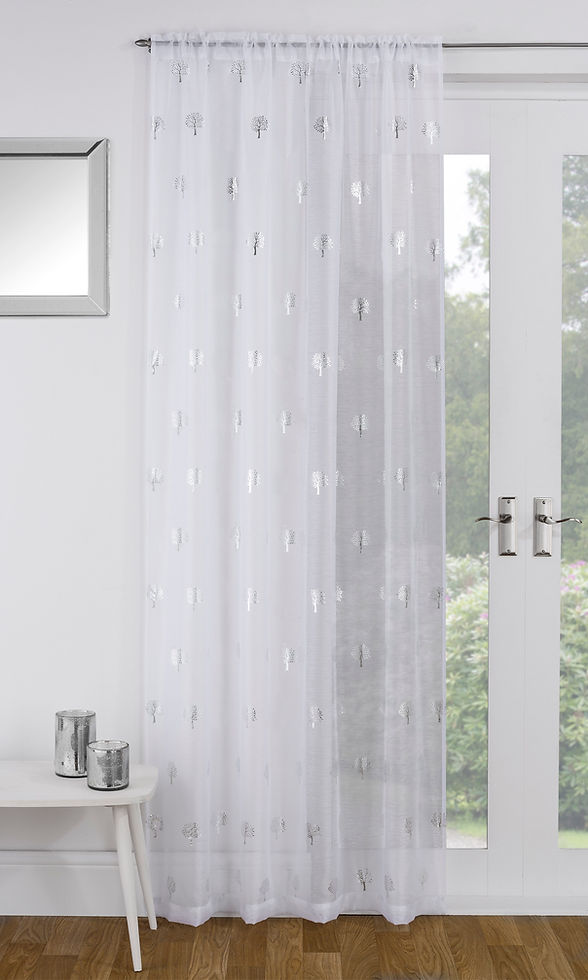
Birch White is one example of a voile-panel option to show in a comparison. Seeing a full-length panel alongside a net sample helps the customer judge the difference in presentation, not simply the difference in terminology.

Be precise about privacy
Neither ‘net’ nor ‘voile’ should be sold as a guarantee of complete privacy. Both are sheer window treatments. How much can be seen through them depends on the fabric, the amount of gathering and the balance of light inside and outside.
During daylight, a sheer treatment may reduce the view into a room. At night, with lights on indoors, people outside may still be able to see in. Customers who need evening privacy should consider an additional curtain, blind or other suitable covering.
A useful in-store demonstration is to hold a sample against both a bright window and a darker background. If possible, show the same fabric flat and gathered. That gives a much more realistic impression than a single close-up photograph.
Three details that prevent an unsuitable purchase
First, confirm the finished drop. Measure from the intended hanging point to where the customer wants the fabric to end, rather than assuming a standard window height. Ask about radiators, sills and doors that may affect the preferred length.
Second, check the heading and fitting. A customer with a wire, track or pole needs a compatible product and enough room for it to hang properly. Explain any accessories needed before they reach the till.
Third, talk about width and fullness. The amount of fabric needed depends on the window span and the look the customer wants. Use the particular product's sizing guidance rather than applying one universal rule to every net and panel.
Give each option a clear place on the shop floor
A compact side-by-side display works well: one net curtain, one voile panel, a clear indication of how each hangs and a small note about the type of window each might suit. Keep samples within reach so customers can feel the fabrics and compare their transparency.
Group by the question customers are trying to answer — daytime screening, full-length softness or layering with curtains — rather than placing every sheer product in one undifferentiated run. This makes the range easier to navigate without suggesting that one format is universally better.
When a customer is undecided, return to their window, their fittings and their privacy expectations. The best recommendation is the one that meets those practical needs and looks right in the room. A clear explanation now is worth more than a quick sale followed by a return.


